The problem with inline actuators
The main way I tackled this was find ways to eliminate Inline Actuators.
Stewart platforms usually place their actuators directly between the platform and the ground — "inline actuators" — because this is usually the simplest way to mount them and reduces number of parts. But — as the platform moves laterally, these heavy actuators sway side to side, resulting in slower performance and lower max operating frequency.
The video below shows a standard Stewart platform in action — notice the actuators swaying side to side as the platform moves laterally.
Ideation
We first started by ideating a bunch of different concepts to achieve 6DOF motion without placing the actuators in-line. The goal was to come up with as many ideas as we could without worrying about feasibility and performance just yet. Here are some of the many ideas we came up with.
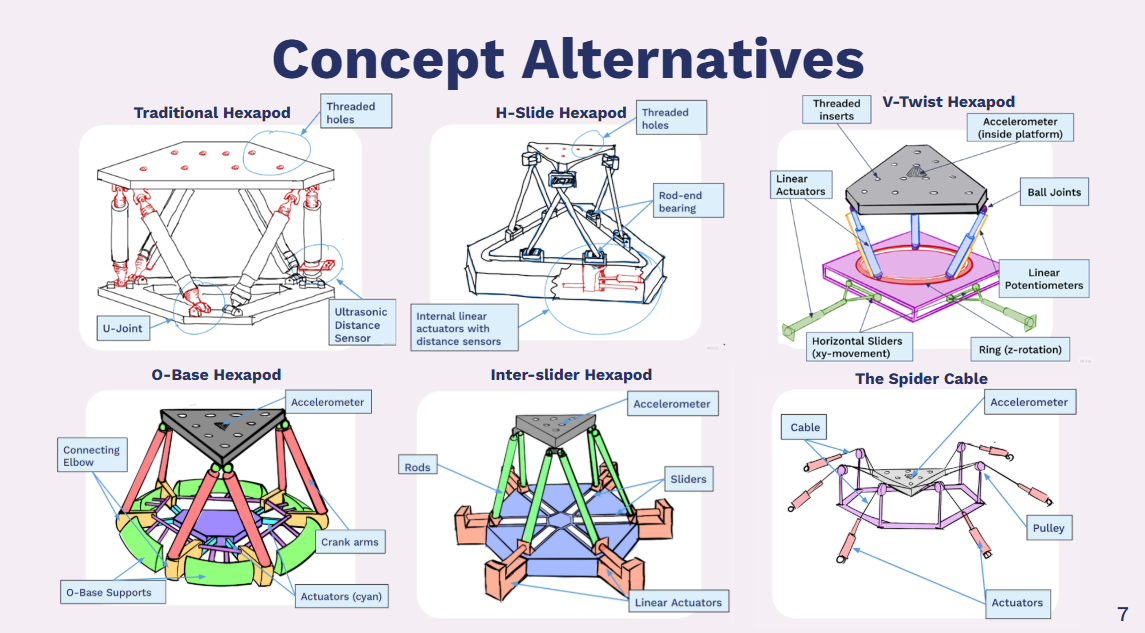
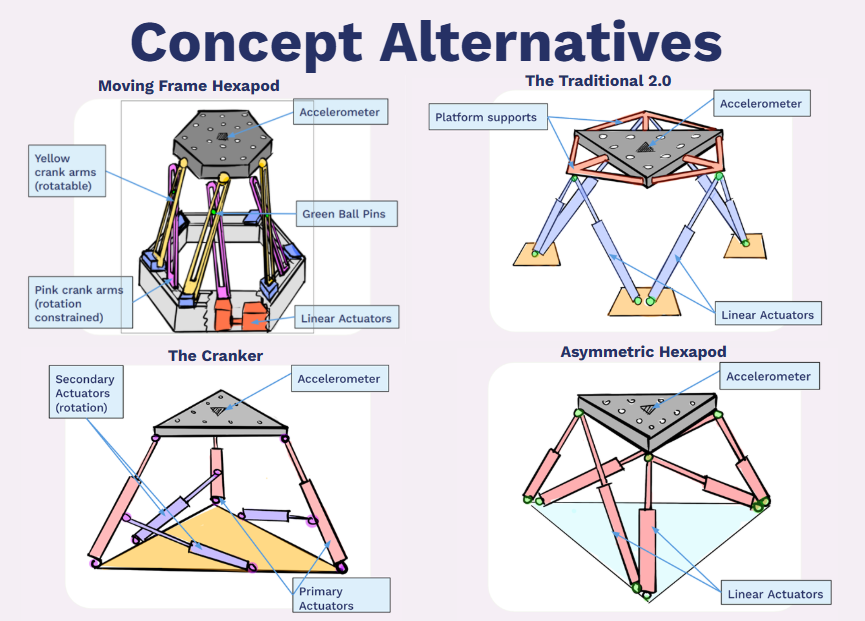
As you can maybe tell, Some of these are quite simply not feasible or not the best idea, but there were some interesting options! We used a combination of different ranking and scoring methods across our primary evaluation criteriaEvaluation CriteriaMotion ResolutionPayload CapacityHigh Frequency ResponseMotion Range to select a final solution to move forward with: the "Bellcrank Operated Hexapod" - A concept I had suggested!
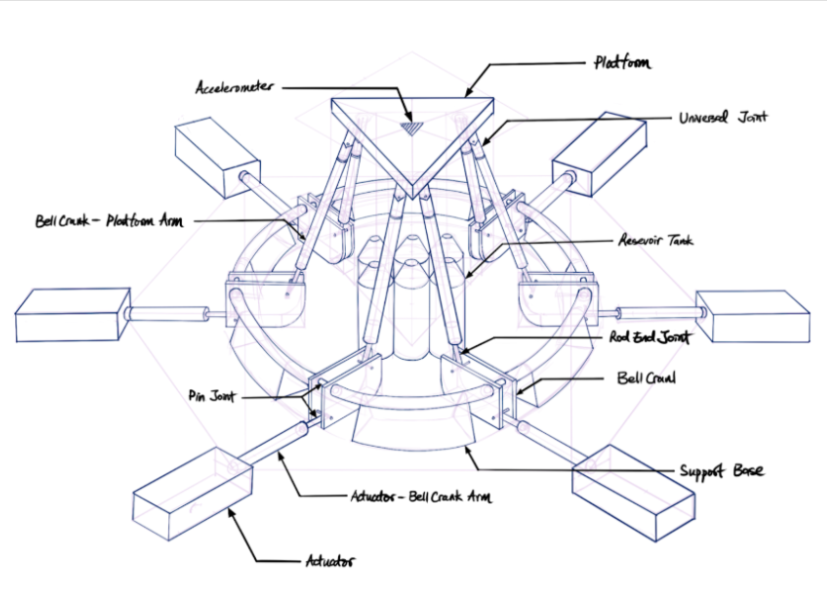
The Bellcrank Operated Hexapod
The concept was to use a bellcrank linkage to decouple the actuator from the platform. This would allow for our actuators to sway much less, and we can make the swaying platform arms very lightweight so they don't limit the dynamic performance.
But the magic of this concept is that with our bellcranks, we can also configure the motion ratio (the mechanical advantage) , which is the ratio of actuator movement vs platform movement. If the motion ratio is high, the actuator velocity and acceleration will be amplified, further improving the dynamic performance of the platform (at the expense of stiffness)! The bellcranks can also have multiple motion-ratios, so you can configure the behavior of the platform based on your application! You choose if you want a quicker platform or a stiffer one!
Now, we had a basic concept — but I had to optimize the geometry to actually achieve the performance we needed! Taking us to the Geometry Optimization Page.